Your organisation’s decisions, private by construction
Compare exact live agents, apply one frozen policy and keep the decision beside the configs, eval sets and reports your team actually runs on. Members see the room; nobody else sees that it exists. Enforced by row level security in the database, not by a checkbox in the interface.
Free while accounts open. Files up to 50MB each; invites by email, one use each.
What private, evidence-bound work means here
Six statements, each one enforced by the database rather than promised by the page.
Private by the database, not the interface
Every table behind the workspace carries row level security: a member sees their organisation's rows, everyone else sees nothing, including anyone talking to the API directly. The interface could be replaced by curl and the privacy would hold.
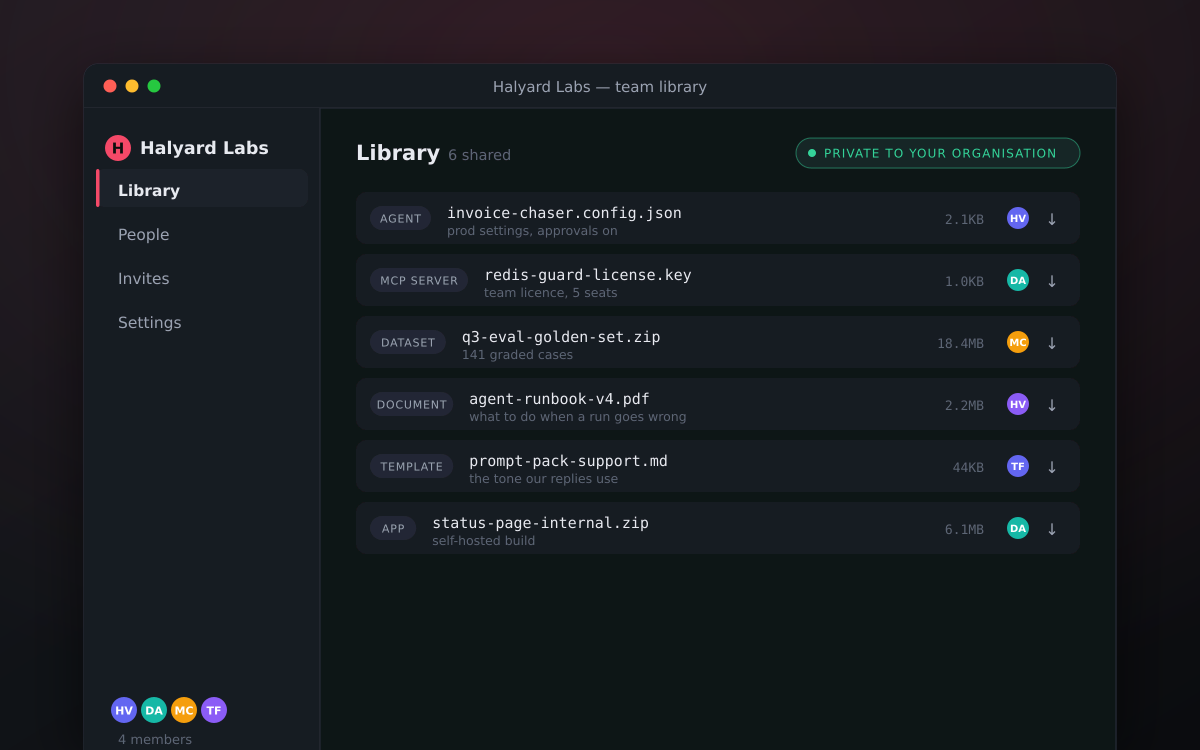
One library for the things a team actually shares
Agent configs, MCP server licences, eval sets, runbooks, prompt packs, internal builds. Each file carries a kind, a one-line description and who shared it, so the library reads like a catalogue rather than a downloads folder.
Downloads are signed, never public
The bucket has no public URLs. A download is a signed link scoped to the file and the hour, issued only to a signed-in member. Nothing an org shares can be hot-linked, crawled or guessed.
Roles that match how teams work
Owners and admins manage people and invites; members share and download. An invite is tied to the email it was issued to and dies after one use. Owners cannot be removed by anyone but themselves.
Approval stays bound to the evidence reviewed
A case stores the exact receipt-backed versions, the frozen policy, every deterministic check and an immutable timeline. A different owner or admin makes the final decision, and refreshing evidence creates a new revision instead of rewriting history.
The same premises as the catalogue
Your team already evaluates what it buys here against a published rubric. The workspace keeps the artifacts of that work, the configs, the reports, the golden sets, next to the shop they came from.
Bring the decision into the room
Create the organisation, invite a second reviewer, then start from any exact-live Decision Room. The evidence, policy result and approval history stay private to your team.
Create your organisation